
Reconstruct Limestone County's Former Owner Timeline
Start with the newest deed you can find, then work backward through the grantors. The modern Probate index covers recent years. For older property records, the county Archives collections reach surprisingly far back in time.
The two sources are not one seamless database. Recent instruments come through the Judge of Probate's Syscon search or the recording counter. Older owners turn up in the Archives Master Index, the book browser, and microfilm. The direct and reverse indexes also list them. Note which channel supplied each link. That habit lets a reader tell an index hit apart. It distinguishes an inspected deed from a certified copy. Every step should cite its source plainly.
| Source | Years It Covers | Where Held | What It Shows |
|---|---|---|---|
| Current Probate system | Coverage not verified | Syscon / Probate office | Modern instrument leads |
| Deed volumes | 1825-1863 | Limestone Archives catalog | Early conveyances by volume |
| Direct/reverse indexes | 1879-1985 ranges | Archives books | Grantor and grantee routes |
| Master Index | County era from 1818 | Archives online and office | Record-number and document leads |
Start with the Probate search for newer instruments. Older chains lead to the Archives book browser and its historical index ranges. The cutoff between the two tools is not published, so test both as your Limestone County property records search moves back in time.
Build a Limestone County Deed Chain Backward
Give every supported transfer its own row. Record the instrument date and the recording date separately. Copy the legal description too, because that anchor confirms each deed in the parcel chain points to the same tract.
| Transfer date | Grantor to grantee | Deed type | Book/page |
|---|---|---|---|
| Newest supported date | Prior owner to current grantee | As indexed | Exact reference |
| Earlier supported date | Earlier grantor to prior owner | As indexed | Exact reference |
| Historical date | Names from direct/reverse index | As recorded | Archive volume/page |
Never fill a gap with a guess. In Limestone County deed records, a probate distribution, correction, quitclaim, or re-recording can break a simple buyer-seller sequence.
Search Limestone County's Former Owners at Archives
The official Limestone County Archives page opens the path. It links the Master Index, the catalog, office access, and copy instructions.
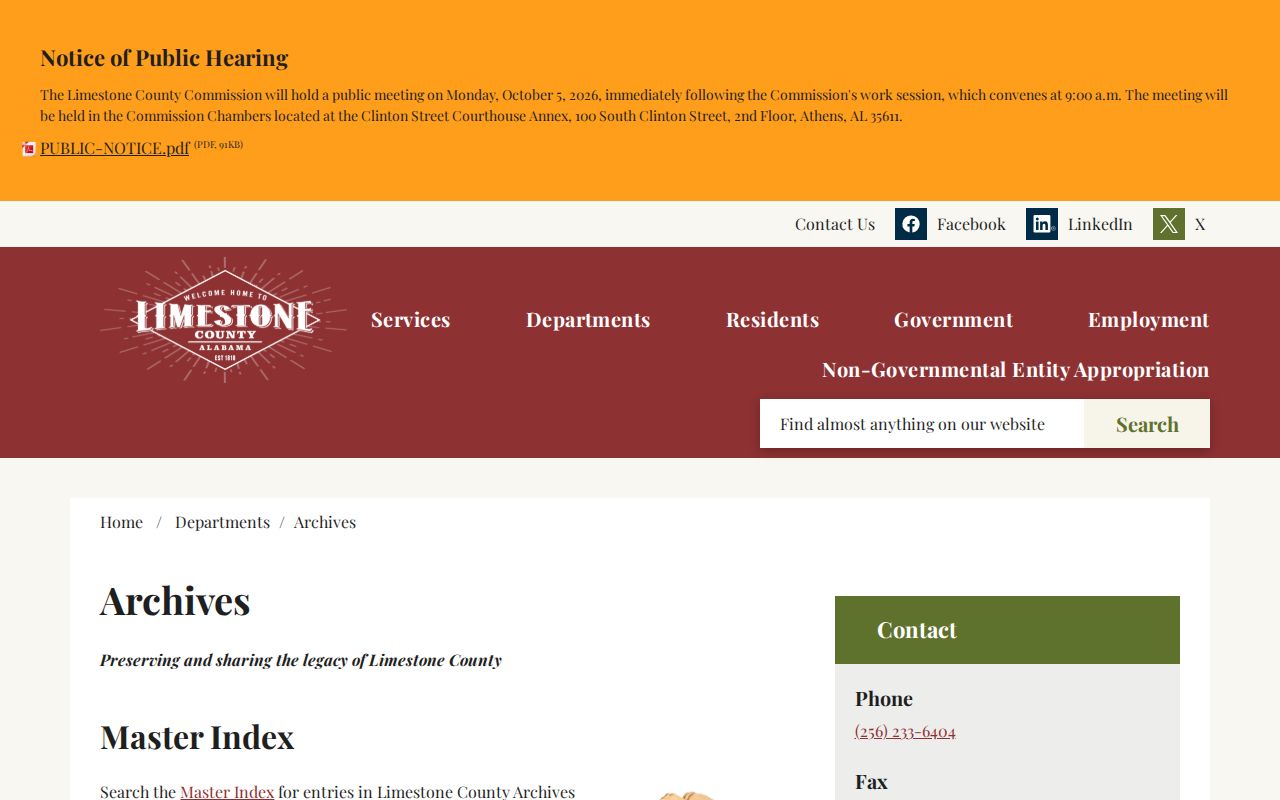
Bring Archives a precise request built from a name, place, record number, or book reference. Staff there do not conduct research for requesters, so keep the index entry you find.
Trace Limestone County's Previous Owners Through Grantors
Start from a verified newer deed and work backward. Searching only the modern owner as grantee stops too soon. Each grantor you identify becomes the next grantee to search.
- Find the present owner's acquiring deed and verify the parcel description.
- Record the grantor, instrument date, recording date, deed type, and book/page.
- Search that grantor as an earlier grantee and match the land description.
- Repeat in direct/reverse indexes and deed volumes when the web trail ends.
- Grantor / grantee
- The conveying and receiving parties named by the instrument.
- Chain of title
- The supported sequence of recorded ownership instruments.
- Reverse index
- An index route used to find a person as grantee.
- Warranty / quitclaim
- Different deed forms whose legal effect should not be assumed from the label alone.
Find Limestone County Former Owners Under Old Place Names
An old Limestone County deed rarely speaks in modern addresses. Instead, it may locate the land by community, rail line, road, section, monuments, or the names of adjoining owners. That matters for a former-owner search. Fort Hampton became Elkmont in 1866. Austin became Ardmore in 1914. Running a property search under both the old and new place names can restore a broken chain of prior owners.
Before accepting a match, confirm it. Acreage, boundary calls, a plat or deed reference, and neighboring owners should all line up. A newspaper notice or obituary can point to a person, but only the recorded transfer proves title. Limestone Archives' "In Memory" collection blends obituaries, tombstones, and funeral programs, so treat it as a lead rather than deed records evidence.
Names shift too. Initials, spelling variants, marriages, estate styles, and business suffixes all hide owners of record from a casual search. Start with the exact form on the latest supported deed, then test only variants backed by another record. A shared surname or community never ties a person to a tract by itself.
Use Limestone County Archives for Prior Owners
Limestone County Archives is the central repository for older property records. It reports more than 350,000 Master Index entries and over 6,000 cataloged books and files. Holdings come from Probate, Circuit, Revenue, County Commission, Board of Education, and Board of Registrars. They reach back toward the county's 1818 organization.
You can search online, visit 102 W Washington Street in Athens, or order copies. Copies cost $1 per document. A certified copy runs $5, and postage adds $1 per ten documents. Allow two to four weeks for delivery. Loose Probate or Chancery files may need a special quote. They must be copied as a unit. The Archives does not perform research for you.
The Archives sits in the former 1905 L&N Depot. It anchors the record trail to a real local landmark. Dates still govern, though. Organization in 1818 does not mean every deed series begins then. The documented 1825-to-1863 volumes carry their own stated span, and neither end should be stretched.
Resolve Breaks in Limestone County Ownership History
Few ownership chains in Limestone County run perfectly clean. Estate transfers, fiduciary deeds, corrections, releases, re-recordings, subdivision plats, and parcel splits can each snap a link. Match the legal description at every step. Link a predecessor or successor parcel only when a recorded instrument supports it.
A changed lot and block, a retired parcel, a new phase, or two modern parcels citing one old deed is a clue. A clue is not proof. Check Probate for the recorded land instrument. Turn to Circuit Clerk records when a quiet-title, partition, boundary, or lien case might explain the change.
Note: A recorded instrument can establish a chain link, but only qualified title review can assess competing legal interests.
Measure Limestone County's Former Owner Time Depth
Limestone County organized in 1818, and its archive reaches nearly that far back. Surviving series carry their own spans, including deed volumes from 1825 through 1863 plus later direct and reverse index ranges. So avoid calling the county's property records continuous, or assuming everything sits online.
Older owners require the books. The live recorder portal's cutoff was not verified. When online searching stops, use Archives indexes, microfilm, deed books, and Probate staff rather than guessing.
Former-owner research in Limestone County serves real purposes. It anchors a house history. It settles estate questions, and it shows how a parcel changed hands across decades. Deed records, plat maps, and the tax roll each reveal a piece of that chain. One caution applies throughout. Never use historical or current owner data to stalk, target, or harass a living person.
When you contact an office, bring specifics. Give exact names and approximate years. Include the deed type, legal-description terms, and the latest book/page reference you hold. Probate serves as the land-record custodian, while Archives holds the historic material. The Archives Master Index searches names, descriptions, and places. Its book form adds years, department, record number, and microfilm details. Save any index result before ordering copies. Certified and informal copies carry different fees and different uses.
Keep a Limestone County Former Owner Log
Build a former-owner log for each Limestone County parcel you trace. Record the indexed name exactly as written. Note the party's role as grantor or grantee. Also add the instrument type, instrument date, and recording date. Add the book and page, subdivision, lot and block, and acreage. Include the phrase tying the legal description to the next deed. Preserve old spellings instead of quietly modernizing them.
Mark every gap rather than papering over it with a guess. Tax rolls, obituaries, newspapers, and maps can support an identity or a date. Even so, the backward chain should keep those clues separate from actual conveyances. When a correction or re-recording appears, keep both references and note which came first. The result is a Limestone County property history you can audit. It also carries less risk of merging two people who share a surname.
Office requests go smoother when you bring the book, page, record number, and party name. Bring the date range and parcel or subdivision clue you already have too. Probate and the Archives follow different copy procedures and fee schedules. Say whether you need an informal or certified copy. File each copy beside the chain link it supports.
Grade Limestone County Former Owner Evidence
Give each Limestone County record its own evidence grade. An index entry is only a locator. A deed image is an instrument copy. A certified copy carries still more weight. Tax rolls, GIS owner fields, plats, estate files, obituaries, and court dockets each sit a step further from the deed records themselves. Use those sources to explain a gap. But never drop them into the conveyance sequence as though they were deeds. When a split or subdivision rewrites the legal description, hold onto both the old and new lot, block, acreage, and book/page clues. Wait until a recorded crosswalk ties them together. That discipline keeps the former-owner chain auditable. It also preserves the historical leads that have not yet proven a transfer.